
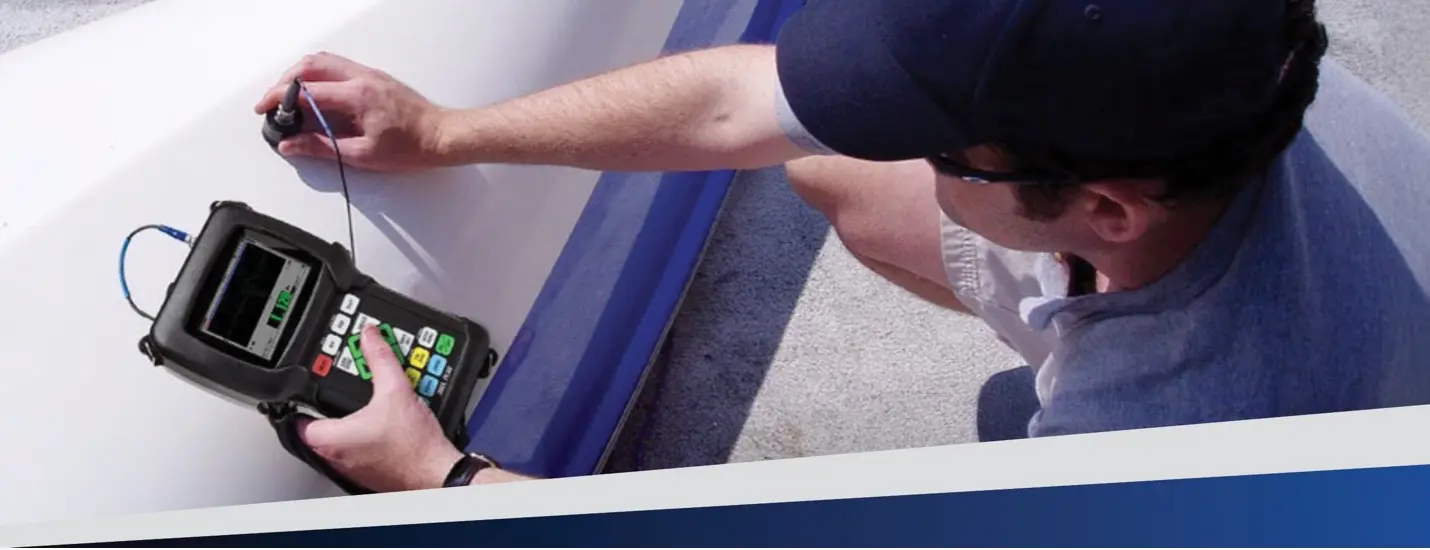
Ultrasonic thickness gauges are incredibly powerful tools. In just seconds you can measure the thickness of almost anything made of metal, plastic, composite, ceramic, glass, fiberglass, or rubber. A thickness gauge, however, is only as accurate as the conditions under which it’s used, the materials in question, and the way the instrument is utilized.
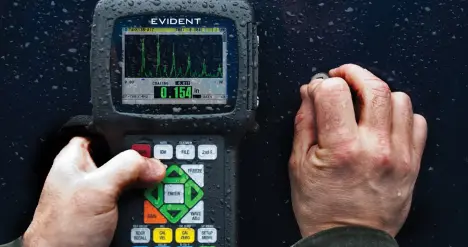
Even the best thickness gauge can deliver misleading results if key variables aren’t properly managed. In our new e-book, “Factors that Affect Ultrasonic Thickness Gauge Accuracy... And the Best Ways to Stay Accurate,” we look at the most common factors that affect ultrasonic thickness measurement accuracy:
- Material Properties Material type, grain structure, elasticity and density, and material temperature can all affect thickness gauge accuracy.
- Sound Velocity Calibration If sound velocity is wrong—even slightly—your thickness readings will be wrong too.
- Surface Condition Surface issues, from scale and rust to curved or uneven surfaces, can play a huge role in thickness gauge accuracy.
- Transducer Selection Different measurement applications require different transducers. Choosing the wrong one can significantly affect thickness gauge accuracy.
- Couplant Use Common couplant mistakes include too little couplant, inconsistent application, or using the wrong couplant.
- Measurement Modes Some modes prioritize penetration, while others prioritize resolution or coating removal—choosing the wrong one can skew results.
- Coatings Nonmetallic coatings slow down sound dramatically, often causing thickness readings to appear thicker than they really are.
- Temperature Even small temperature changes can introduce measurable error—especially in high-precision applications.
- Operator TechniqueEven with perfect equipment and setup, inconsistent technique can introduce error.
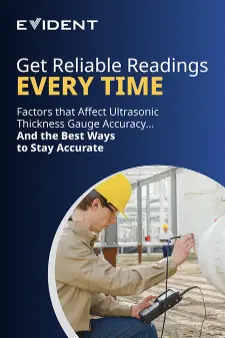
Download Your Free Easy-to-Read Guide
Even high-quality ultrasonic thickness gauges can produce unreliable results if key variables are not properly controlled—sometimes without the operator even realizing it. Download Evident’s new e-book today to explore the most common factors that affect thickness measurement accuracy—and better understand why each one matters.