

With the growth of the clean energy industry, the demand for copper has continued to rise over the past decades. Recently, scrap recycling has gained significant attention within the copper industry. The International Copper Study Group (ICSG) reports that scrap-based refined copper production rose by 5.4% in early 2025. Meanwhile, Copper mine production increased by approximately 2.2% in the same period[1] .
Copper recycling chain
Copper is widely used in electronics, construction, transportation, machinery, and consumer goods due to its excellent physical and chemical properties, particularly its electrical and thermal conductivity, corrosion resistance, and machinability.
Also, copper is one of the few materials that does not degrade or lose its chemical or physical properties during the recycling process. In principle, therefore, every copper item in use can be considered a future source of copper production.
Recycling not only supplements mine production but also offers significant environmental benefits. With proper processing techniques, efficient copper recycling enhances sustainability by minimizing energy input, greenhouse gas emissions, and waste.
As with most other metals, the general copper recycling process typically follows these steps shown in Picture 1.
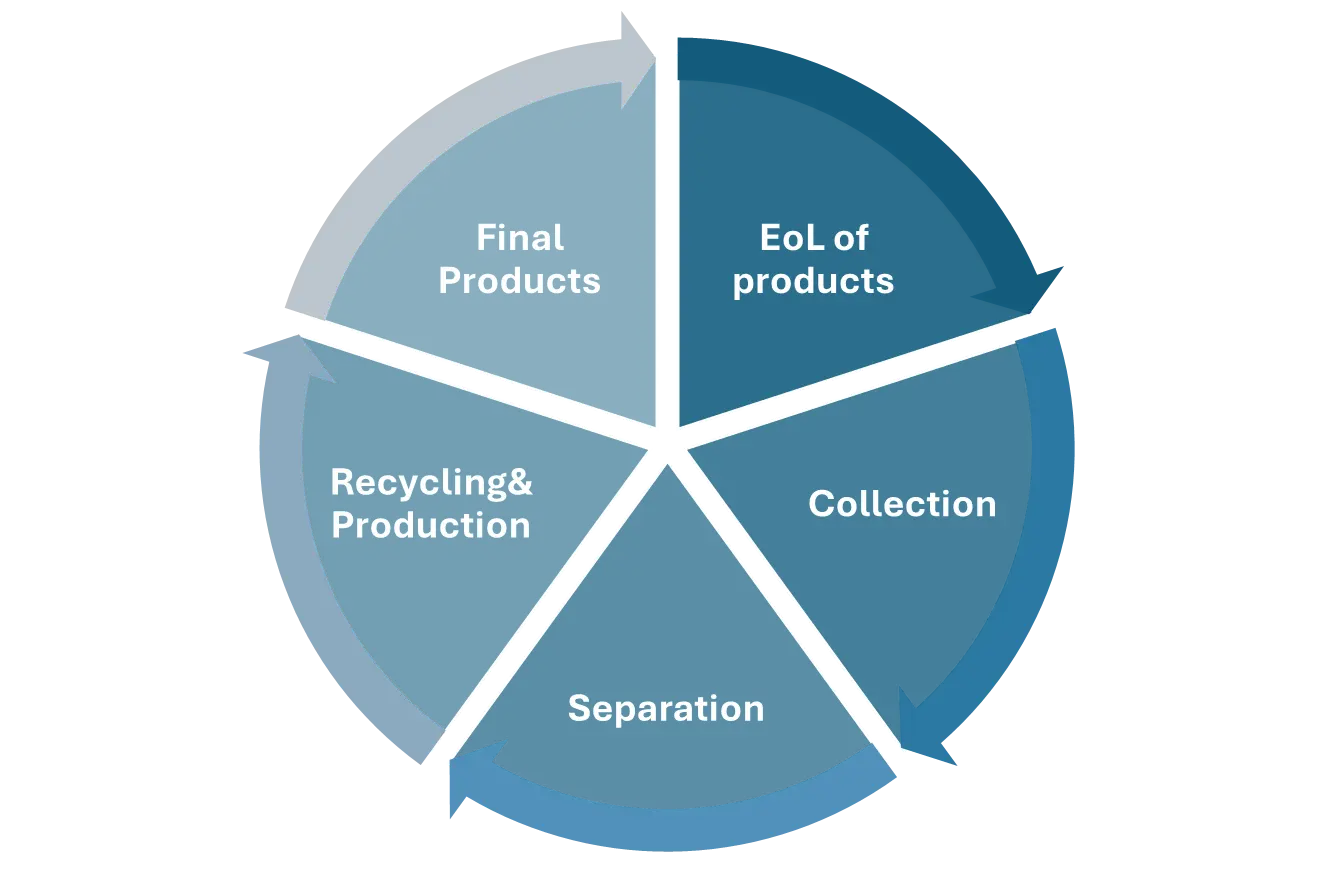
Picture 1: Copper recycling chain
Current challenges in copper recycling
Advances in manufacturing processes have led to a reduction in production scrap. Consequently, most copper scrap now originates from end-of-life (EoL) products across various industries. Even within the same sector, the chemical composition of copper alloys can vary significantly. As a result, we are now facing with a highly complex scrap stream, which differs not only in alloying elements but also in the containments introduced during their previous applications.
Depending on the intended applications, different alloying elements are added to refined copper and need to be controlled to create specific types of alloys. The table below outlines common copper alloys and their uses.
As a result a clear breakdown of common copper alloy families and how they correlate to the five main fields of application buildings, consumer and industrial products, transport and electrical uses was produced.
Table 1. Common copper alloys and their usage. [2][3]
| ALLOY UNS No. | COMMON NAME | NOMINAL COMPOSITION (Wt%) | MAJOR USAGE |
|---|---|---|---|
| C11000 | Copper | 99 min Cu | Electrical conductors |
| C12200 | Phosphorus Deoxidized Copper | 0.025 P | Plumbing tubes piping |
| C17200 | Beryllium Copper | 1.90 Be | Springs, wear-resistant parts |
| C23000 | Red Brass | 15 Zn | Screw machine parts |
| C26000 | Cartridge Brass | 30 Zn | Cartridge cases, automotive |
| C28000 | Muntz Metal | 40 Zn | Architectural, heat exchangers |
| C42500 | Tin Brass | 10 Zn – 2 Sn | Electrical switches, springs |
| C51000 | Phosphor Bronze A | 5 Sn – 0.2 P | Springs, bellows |
| Springs, bellows | Phosphor Bronze D | 10 Sn – 0.2 P | Heavy-duty springs, bearings |
| C65500 | High Silicon Bronze A | 3.3 Si – 1.0 Mn | General applications, wire |
| C70600 | Copper Nickel, 10% | 10 Ni – 1.4 Fe | Marine condensers, piping |
| C71500 | Copper Nickel, 30% | 30 Ni – 0.7 Fe | Marine condensers, piping |
| C74500 | Nickel Silver, 65-10 | 25 Zn – 10 Ni | Optical instrument parts, decorative items |
| C75200 | Nickel Silver, 65-18 | 17 Zn – 18 Ni | Decorative, zippers |
Table 1. Common copper alloys and their usage.[2][3][4]
When a product reaches its End of Life (EoL), it often carries over various contaminants from its service environment. Common impurities include iron, oil, water, plastic, sand, aluminum, lead, tin, nickel, bismuth, silicon, zinc, and antimony.
These contaminants must be removed prior to further processing. Failure to do so can lead to increased production costs, diminished product quality, compromised worker safety, and environmental concerns—all of which can ultimately harm customer relationships.
How can Vanta help during copper recycle chain?
To increase the efficiency and revenue of copper recycling without downing the quality, developing good sorting and separation technologies is critical.
The Vanta™ handheld XRF analyzer provides grade identification and accurate chemical composition of purchased scrap in just a few seconds.
Using the built-in Pass-Fail feature, the analyzer helps operators to immediately make decisions during buying and selling in separating copper grades according to the basic following categories.
| Copper grade types | Typical copper content | Typical source |
|---|---|---|
| #1 Copper | >96% | Pipe |
| #2 Copper | 94-96% | Pipe, wire |
| #3 Copper | 88-92% | mixed scraps, coated material |
Also some special copper scraps also contain other contaminants, hazardous elements or even valuable metals, such as gold, silver, tin, and lead requiring deeper analysis so these metals can be recovered or eliminated through subsequent processes. Providing the full chemistry of the alloy in few seconds, Vanta analyzers help operator sorting accurately raw material.
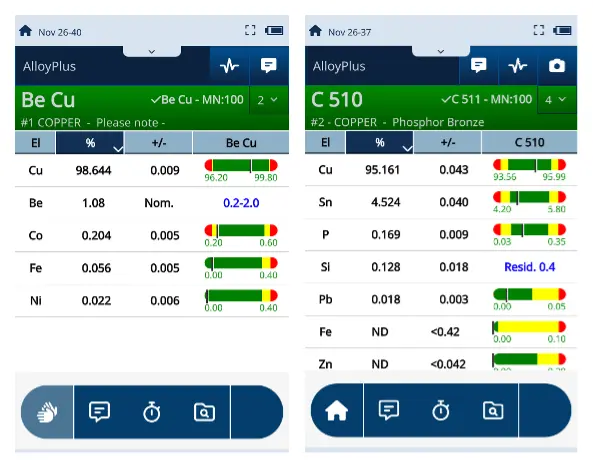
Figure 1 Vanta result with clear pass fail and Copper grade type information for fast decision making
Vanta™ handheld XRF analyzer for copper scrap
The Vanta™ handheld XRF analyzer incorporates state of the art electronics including proprietary Axon™ technology to provide outstanding accuracy and repeatability test from the 1st to the last analysis of the day with high sensitivity for low element concentration.
Our standard grade library includes common alloy grades which comply with major international ally standards.
For copper industry professionals, we offer a wide range of common copper alloy grades in our library, can start your everyday work without complicated set-up. This promised analysis performance with the wide range of available chemical elements (from Mg to U), the built-in grade library and easy to use software give operators confidence in every test and every decision they make throughout the recycling chain.
Reference:
- International Copper Study Group. (2025). *Press Release: ICSG Copper Statistical Yearbook 2015-2024 (2025 Edition)*. Lisbon, Portugal: International Copper Study Group. Available at: https://icsg.org/download/2025-10-press-release-icsg-copper-statistical-yearbook-2015-2024-2025-edition/?wpdmdl=9009=6913d33f4f1f91762906943 (Accessed: 30 October 2024).
- Copper Development Association (no date) Standard designations for copper and copper alloys. A1360/01. New York: Copper Development Association. Available at: https://www.copper.org/publications/pub_list/pdf/a1360.pdf
- ASM International (2001) Copper and Copper Alloys. Edited by J.R. Davis. 1st ed. Materials Park, Ohio: ASM International.
- Copper Development Association Inc. (2021) Copper Alloy Datasheets. [online] Available at: https://www.copper.org/resources/properties/db/ (Accessed: 28 November 2024).